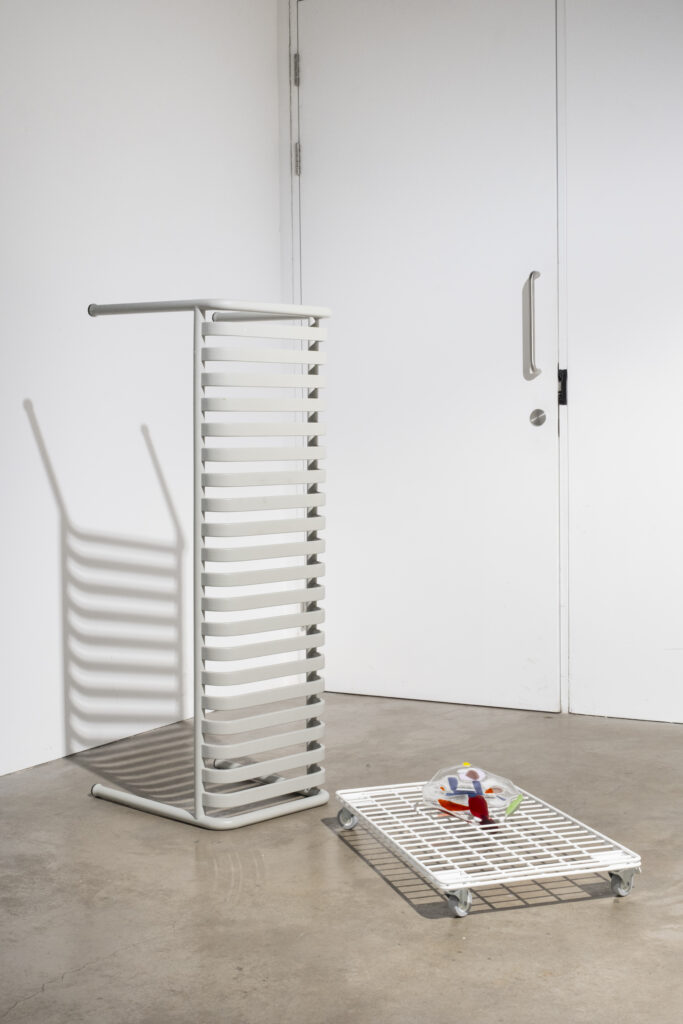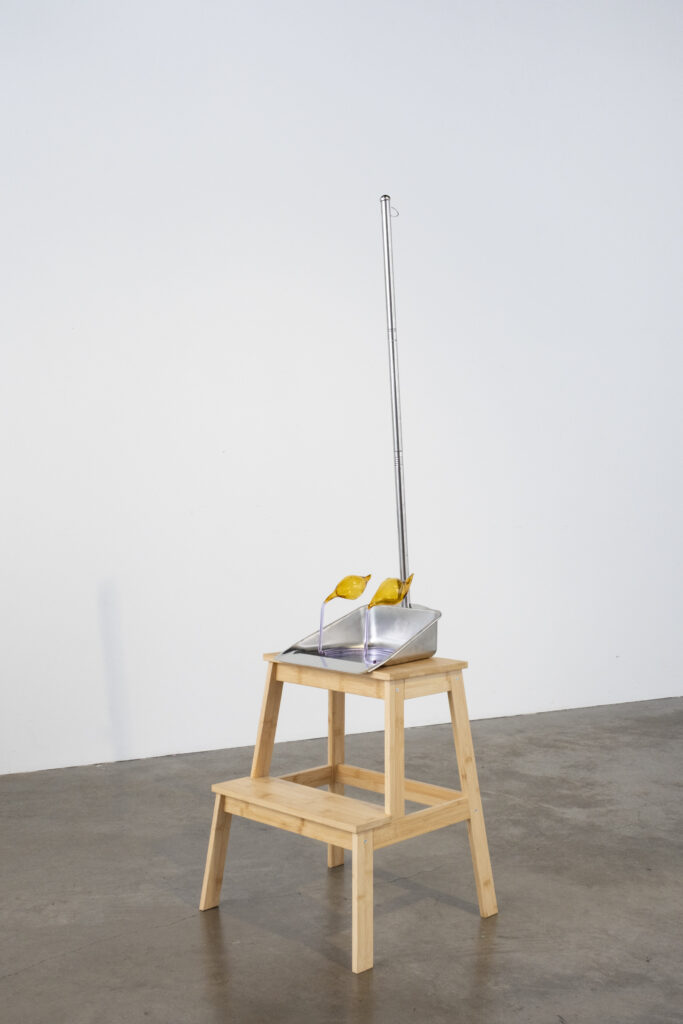
Now is not the time economically to be switching jobs or creative fields, but that hardly seems to concern the artist Godelive Kasangati Kabena. Brilliant and unconstrained, she moves fluidly across disciplines, able to shapeshift at any moment into a blacksmith, glassblower, writer, photographer, performer, or even become the very medium through which the work is presented publicly in artistic spaces. The epitome of interdisciplinary artistry, not creative hustling. Since 2021, when she relocated from the Congo to Kumasi, Ghana, to pursue her studies in art, Godelive’s creative evolution as a consciously curious artist has been truly remarkable to witness. With each exhibition, she reveals an increasingly precise awareness of both subcultural and mainstream political systems and processes, including the environmental and psychologically constructed structures that influence our everyday life. In this rare and really expansive conversation with us at Random Photo Journal, Godelive reveals more of herself further, demonstrating why artists and curators alike trust her to articulate, interpret, and reimagine both art and the artistic process. The nitty-grittiness of her work reflects a deep attentiveness to how Africans, humans and the animals they chose to keep alike interact with their environments. Her practice persistently investigates how intercultural systems operate, how they migrate across borders, and whether the structures that govern them function effectively or converge meaningfully. Her engagement and research, and final presentation of the Basenji dog, offer a compelling example of this attentiveness. In this interview, we explore how her perspective on the Basenji becomes a niche yet expansive guide to understanding how an artistic idea should be groomed, researched, created, defined and presented.
On the importance of having conversations in art spaces, it is nice to know that the Basenji dog chronicle started from a simple exchange between Godelive and her curator friend Jean Kamba.
For some like us, just a mention of the Basenji reveals an unexpectedly vast historical trail, stretching from the Congo to ancient Egypt, through the Niger Expedition of 1841, and into the life of Prince Owusu-Ansa of the Gold Coast. Through this exploration, Godelive demonstrates that rigorous thought, like meaningful art, is rooted in curious and obsessive inquiry, affirming art’s essential role in human development. It is obvious that Godelive’s artistic practices are concerned with the political act of creating, archiving, and circulating images of both human and non-human bodies. Working across smithing, glassblowing, performance, installation, and photography, she carefully examines how images move through social, ecological, and institutional frameworks, and how, in turn, they shape our perception and understanding. Through ongoing investigative research, she remains grounded in the foundational ideology of photography while simultaneously expanding the forms and directions through which her ideas are expressed. This evolution has enabled her to develop a more nuanced and assertive artistic language, one that is intellectually rigorous and deeply responsive to the shifting contexts in which her work exists.
Godelive Kasangati Kabena (b. 1996, Democratic Republic of Congo) graduated in painting at the Academy of Fine Arts in Kinshasa, where she began developing her photographic practice. In 2017, she participated in a two-year photography training course initiated by EUNIC-RDC, the Goethe Institute of Kinshasa. Kabena currently lives and works between Kinshasa and Kumasi, where she continues her studies at the Kwame Nkrumah University of Science and Technology.
A simple reference to the Basenji dog quickly sends one down an unexpectedly long historical trail, into ancient Egypt, the Niger Expedition of 1841, and even to the life of Prince Owusu‑Ansa of the Gold Coast. Your work seems to emerge from similarly deep investigations. Thinking back to the very first moment the Basenji entered your thinking: where were you, and what sparked the curiosity that eventually grew into a body of artistic research and installations?
It is important for me to respond to this first question because, in 2019, I went to the Bamako Biennale. That experience opened up a space of potentiality for me in relation to photography. When I returned to Congo, I decided to begin a new body of work centred on images that bring together animal bodies and the human body. Jean Kamba, an important curator from the Democratic Republic of the Congo, saw this work and said to me, “I’ve seen your work, and it’s very interesting. Do you know about the Basenji dog? Maybe you could look into it.” I told him that I didn’t know the Basenji, and he suggested that I research its history online. When I began searching, I realised that the dog does exist, but I was struck by the fact that, although it is said to originate from Congo, I had never seen it on the street. I tried to find archival images, but there were surprisingly few available online. This led me to contact several museums whose email addresses I found. The Africa Museum sent me some images, and I believe the Boston Museum did as well. However, the material from the Africa Museum became central to my research, and I began to study it closely. Through this process, I learned about the dog’s trajectory, including its introduction to England in the 19th century and the establishment of the Basenji Club there in the 20th century. It seems that the breed became particularly appreciated in England, perhaps explaining why such institutions were formed. The Basenji is often described as a gentle dog that does not bark.
I also encountered references linking the dog to ancient Egypt, including its possible presence in relation to the pyramids, as well as hypotheses suggesting that it may have migrated from Egypt to Congo. What interested me was not necessarily the historical accuracy of these claims, but the network of connections they created. This led me to imagine the dog within the colonial period. I began to wonder what might have happened to it, especially given its relative absence in Congolese communities today. My first work in this direction responded to that absence, and to the idea that absence itself can be a powerful and even dramatic. At the same time, I became interested in the evolution of the breed over time. I took many photographs of dogs in the street, noticing that some of the characteristics associated with the Basenji appear in so-called street dogs.
During this period, I also consulted a veterinarian, who, after looking at some of my photographs, told me that these were not Basenjis. This pushed me to return to the question of what defines the Basenji. Archival images then became crucial, offering a way to think not only about the history of the dog, but about the dog itself as something shaped through time. Another layer emerged from the Basenji as a hunting dog, and its close relationship to hunters, households, and domestic life. This opened questions about how relationships between Congolese communities and this dog may have shifted over time. It is possible that these relationships changed during the colonial period, particularly in relation to extraction and exploitation. While this could have become part of the work, for me, it remained more of a starting point in how I engage with the work at the moment. Instead, these links and fragments of information became a space from which I could begin to dig into the dog’s body itself, its experience across time, as well as the images as objects, and what they might offer.
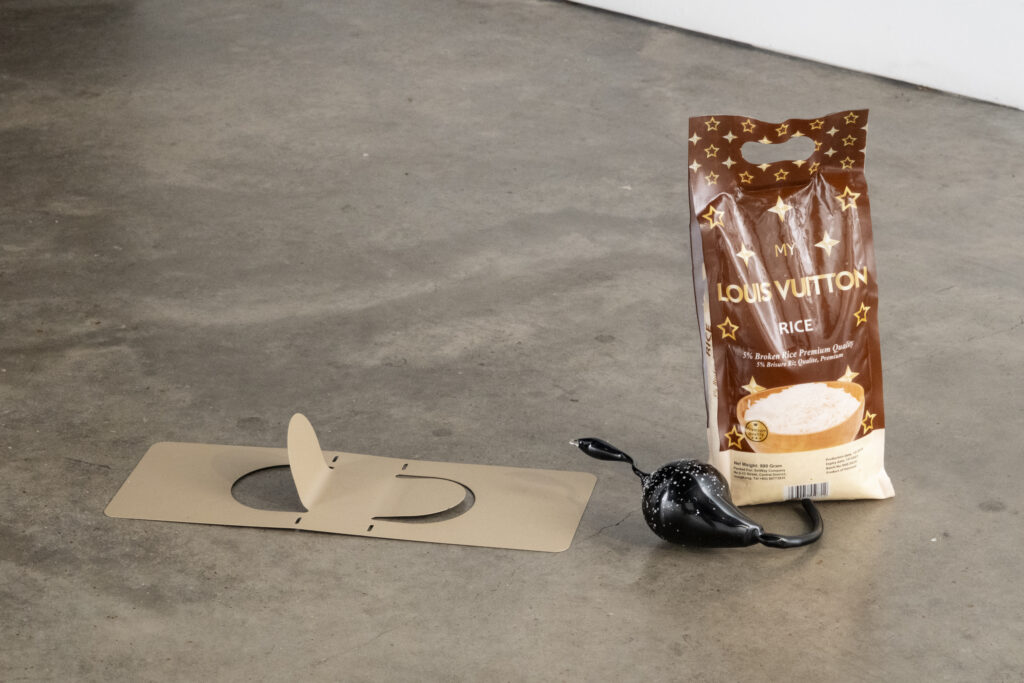
In your Louis Vuitton Rice installation, rice becomes more than a material; it feels almost symbolic. What drew you to rice specifically, and what possibilities did it open up conceptually that another medium might not have offered?
This rice as an object is really crucial for me, and also as a point in time. First, in terms of the production of this work and its position as an important object. While I was dealing with the dog research, about its presence and the possibility of me digging into a historical event, there was also the idea that these archive materials could, at first, destabilise the idea of holism that a picture is always accused of. Because a picture is sometimes accused of being whole, being a container, being that object that has to be seen to be completed, or being seen to live. And for me, I thought this would be really interesting, that these archival pictures of the Basenji themselves could open that layer of discussion where a picture ceases to be a container but becomes this dynamic place. And if it becomes this dynamic place, then what could it become in terms of a picture? Secondly, if we cannot see this picture as a whole, it can also be seen as parts, but how do these parts themselves function? I remember that I was really dealing with the picture of this dog when I first produced this body of work. I thought that this relation to me being interested in this picture could have been maybe another way of thinking of reproducing this picture, because I was cutting them, chopping them in between, and creating these mimic collages. For me, the idea of reproducing the “other” became interesting in terms of these pictures themselves as parts, but not only as a whole.
However, I realised that maybe I could think about how reproducing this image could be a language not for me, but for the picture itself, and how the picture could be reproduced. If the picture could be reproduced, what does it mean for the picture itself and the one that is reproduced? The idea became then that if I cannot reproduce this picture as a picture, it could propose an image. And if it is proposing an image, it is already a political stance for the picture itself and the image that is reproduced.
Thirdly, if we cannot see this picture as a whole, it can also be seen as parts, but how do these parts themselves function? I remember that I was really dealing with the picture of this dog when I first produced this body of work;I thought that this relation and my interest in these pictures could have been another way of thinking of reproducing these pictures. While I was cutting them, chopping them in between, and creating these mimic collages. For me, the idea of reproducing or proposing the “other” became relevant for these pictures themselves as parts, but not only as a whole.
However, thinking about how reproducing these pictures could be a language not for me, but for the picture itself, and how the picture could be reproduced. If the picture could be reproduced, what does it mean for itself and the one that is reproduced? The idea then became that if I cannot reproduce this picture as a picture, it could propose an image, and if it is proposing an image, it is already a political stance for the picture itself and the image that is reproduced.
The relation between this process of reproducing these pictures opens a layer to the objects themselves and how they are reproduced, and which arguments they are creating in this manner, and how this perspective of reproducing this picture creates a self-referential perspective on the picture.
This Louis Vuitton rice that I saw in one of the small shops just close to my house is called “My Louis Vuitton rice.” It is not Louis Vuitton rice, rather “my Louis Vuitton rice” became fundamental just “my” because it reflects the idea of the picture that I was talking about earlier, which cannot only be seen as a whole because it self-disrupts the idea of wholeness itself, and it can be seen as parts. If a picture ceases to be a container and becomes this dynamic place, it is denying the idea of being a whole. And I think this “My Louis Vuitton rice” denied being a whole by being “My Louis Vuitton rice” and proposes a kind of idea of holism and denying it at the same time.
How could this “My Louis Vuitton rice” be seen as a reproduced picture of the Basenji dog? When I am thinking about a reproduced image, which becomes the other, that other is an autonomous entity which does not only have to be a picture that presents itself as accurate as a presence. But here, an image presents itself as a phenomenon or as an argument.
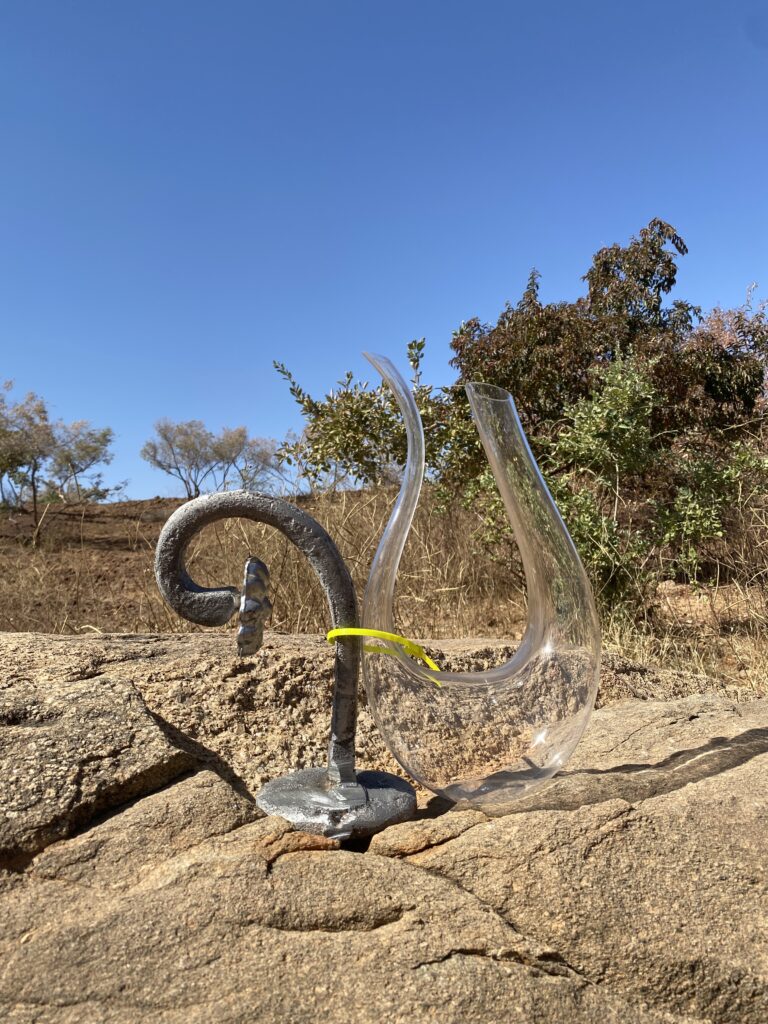
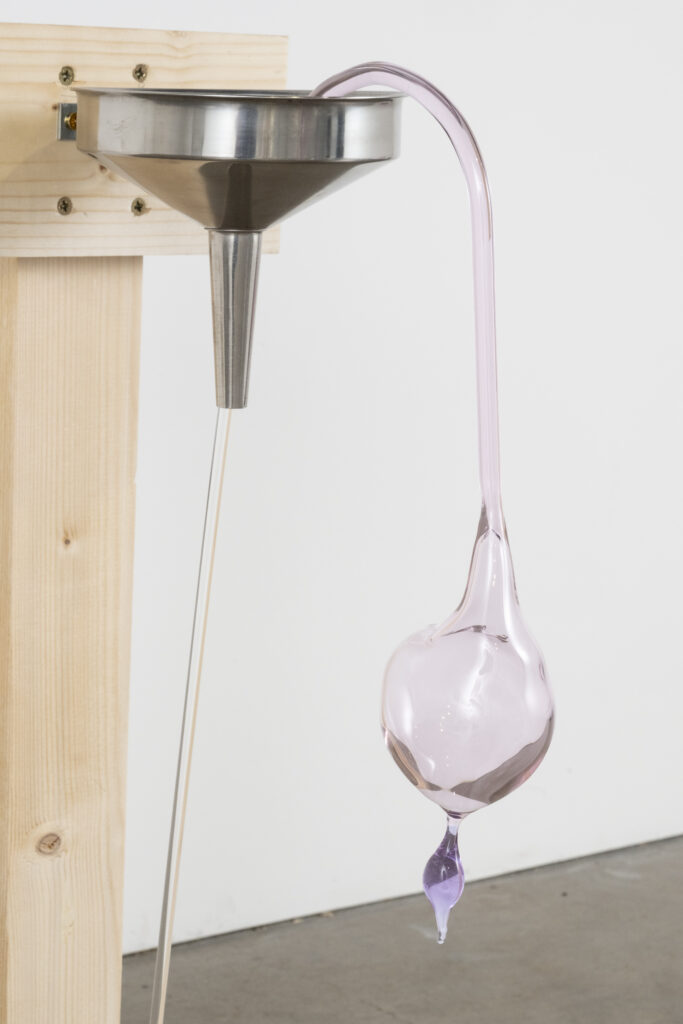
One way to read the Basenji reference in your work is as a metaphor for the layered usefulness or meaning of things and objects, people, histories, and even animals. Does that interpretation resonate with your intentions? And perhaps just as interestingly, what are some of the more unexpected interpretations audiences have brought to your installation?
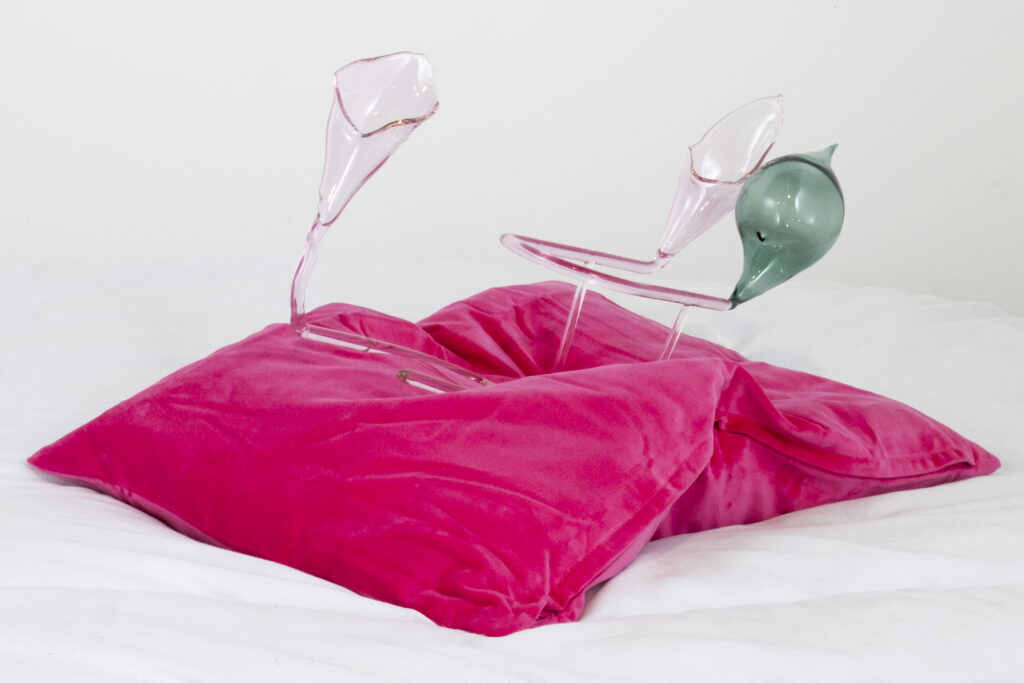
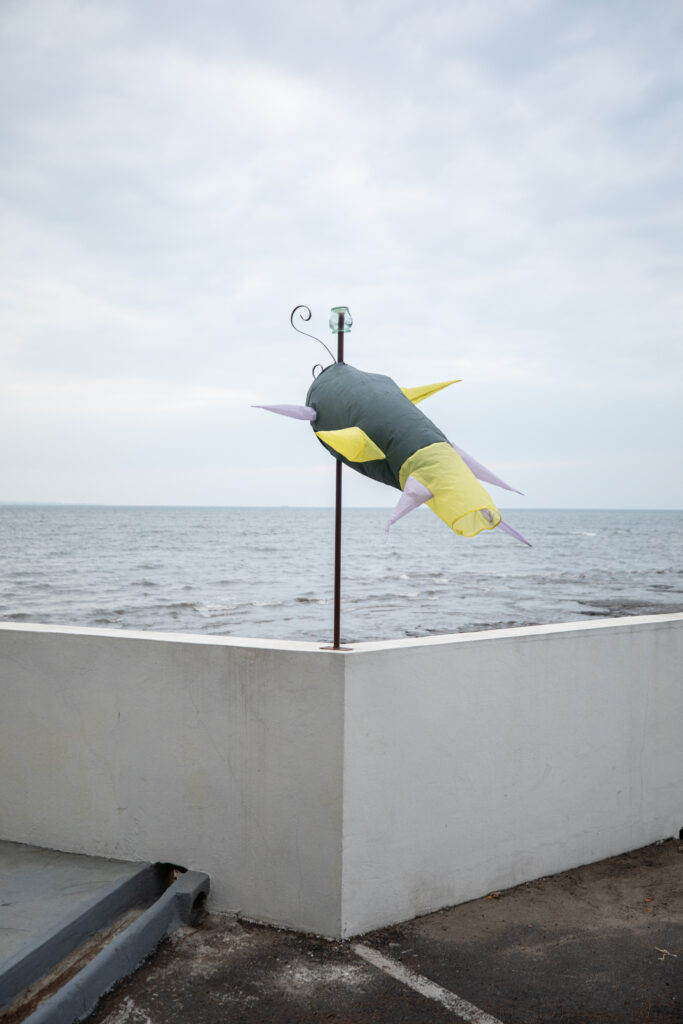
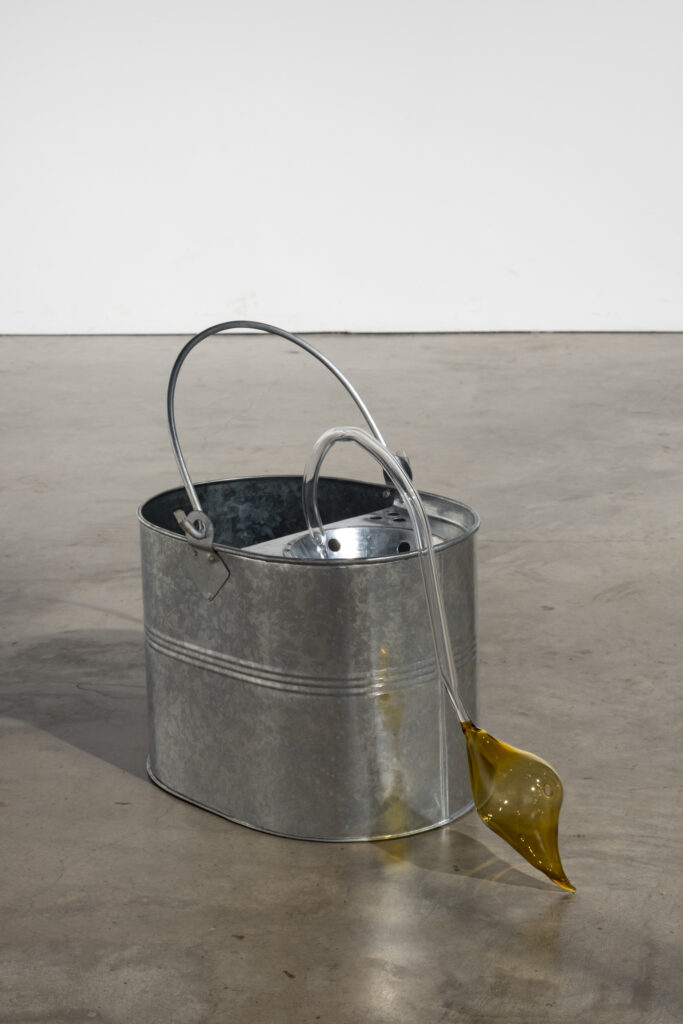
Yeah, for me, I think the Basenji dog is quite like a starting point where I am dealing with a few of the interesting forms and shapes that I have been seeing on the Basenji dog’s body, which itself can translate into many layers. Normally, when a work is already presented to the public, it is out of the artist’s hands. When I was looking at the body of Basenji, I remember that I was even thinking about how the Basenji female can be in heat, also the ears and the tail; these elements allowed me to build objects that could not respond to the shape and form as a reproduced form that only refers to the dog, but rather how they could respond to the idea of the whole and part.
The pheromone release of the Basenji female in heat became a way to think about smell or pheromone as an image. If it is an image, how could this perspective be experienced by the public? Building a plastic sheet structure with a sauna stove was responding to this by becoming an endless possibility of thinking about what the picture of this dog could offer in terms of production. From a historical perspective, going back to the time that this picture was taken in Congo, what it could mean not only for me but for the dog itself to live in houses, to be in the city, and how its relation to hunting behaviour could have changed. And by responding to reproduction itself, which also shifted many things in terms of art-making, distribution, display, or how reproduction itself has challenged many things, maybe in the early 1700s or even before that, but also before the human experience on Earth. Reproduction itself is a phenomenon that humans discovered at a certain point in time, which could be something that goes beyond the human perspective, because it is not only human – it could be anti-human, post-human, transhuman, etc. It can be anything, and for me, it is really a place to think about how reproduction itself has always been a place for discussion. The Basenji dog has opened this perspective on thinking about reproduction in different ways, not only in response to image-making.
I forgot to respond to the last question, about the unexpected interpretation of the audience towards my work. Once I was in Gabon, and one of the people told me that my work was a scam, because he had seen other people really working hard, but in front of my work, what he saw was just an umbrella, a rope, kaolin, and this turning powered by a motor. For him, that work could not have been a work of art, but was a scam.
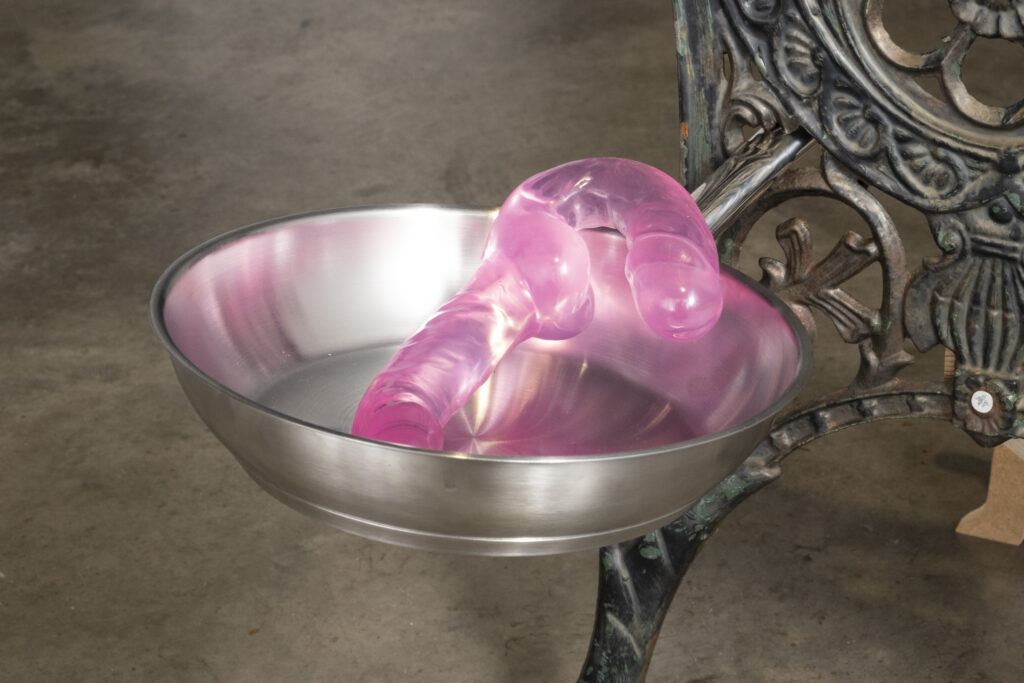
Sex and sexuality appear within the conceptual terrain of your work in ways that feel both deliberate and destabilising. How do these themes intersect with the broader questions you’re asking through your practice?
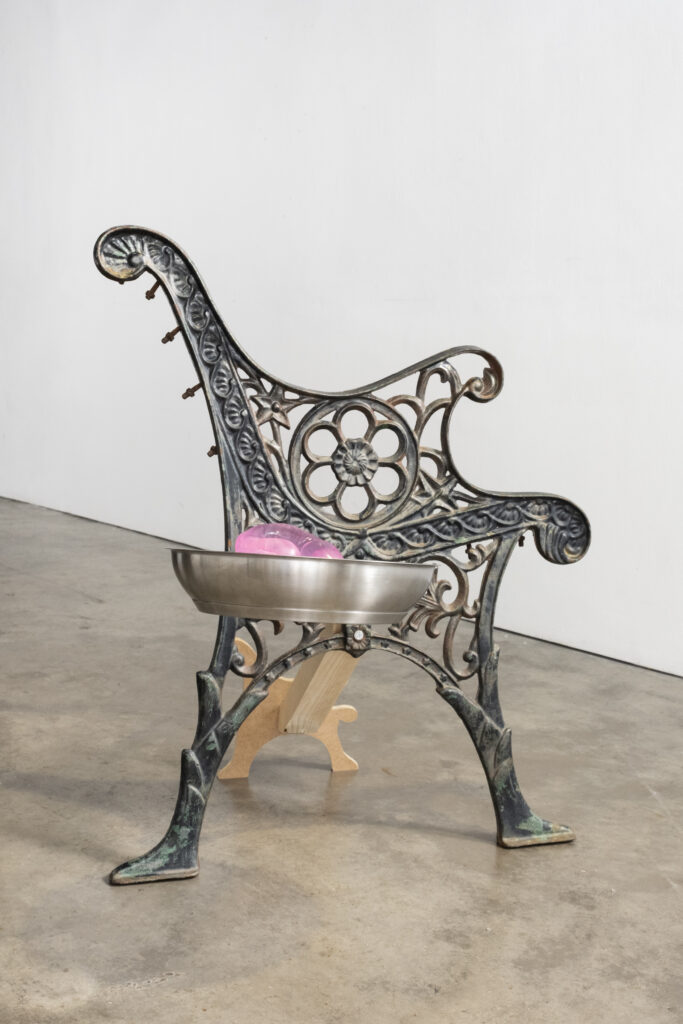
The place of image-making that is sexual, and being experienced as an image –I mention this work, Chumba, this structure where there is a sauna-like stove. When you enter, you are sweating, etc. Therefore, thinking about sexuality and that experience, the heat, as a response to the Basenji female in heat engages with the sauna condition, where one’s body responds to it, but also does not fully respond to it, because the room is not meant only for humans, nor is it a negation of human presence. Rather, the room itself is meant to discuss this idea of what a picture could become.
In this room, sometimes there are synthetic pheromones that are created to calm dogs, and sometimes there are essential oils to simulate this pheromone release.
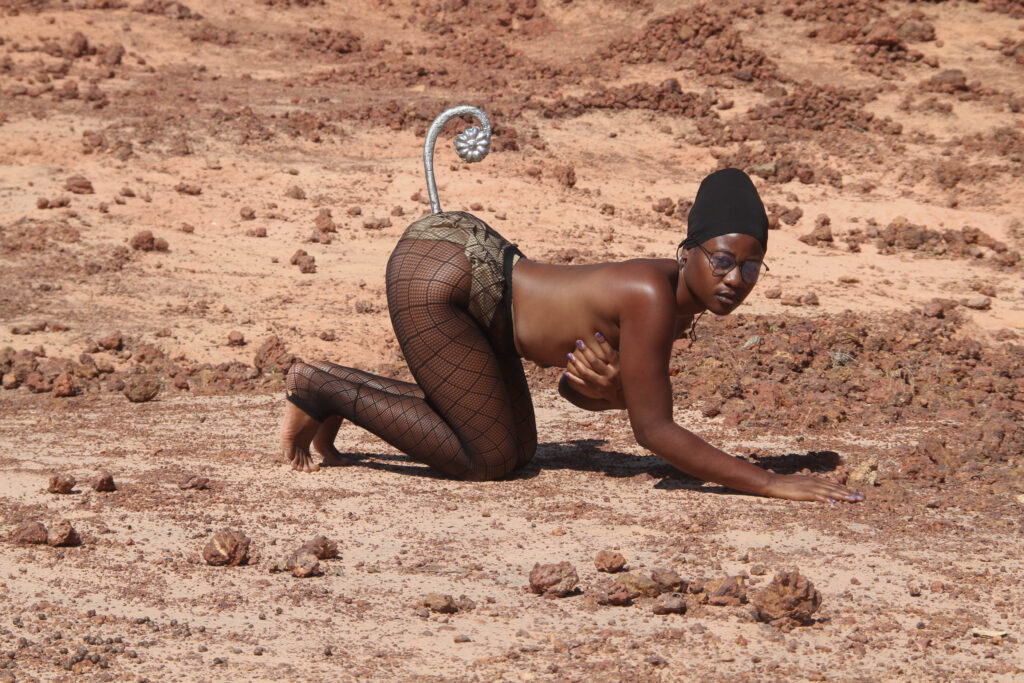
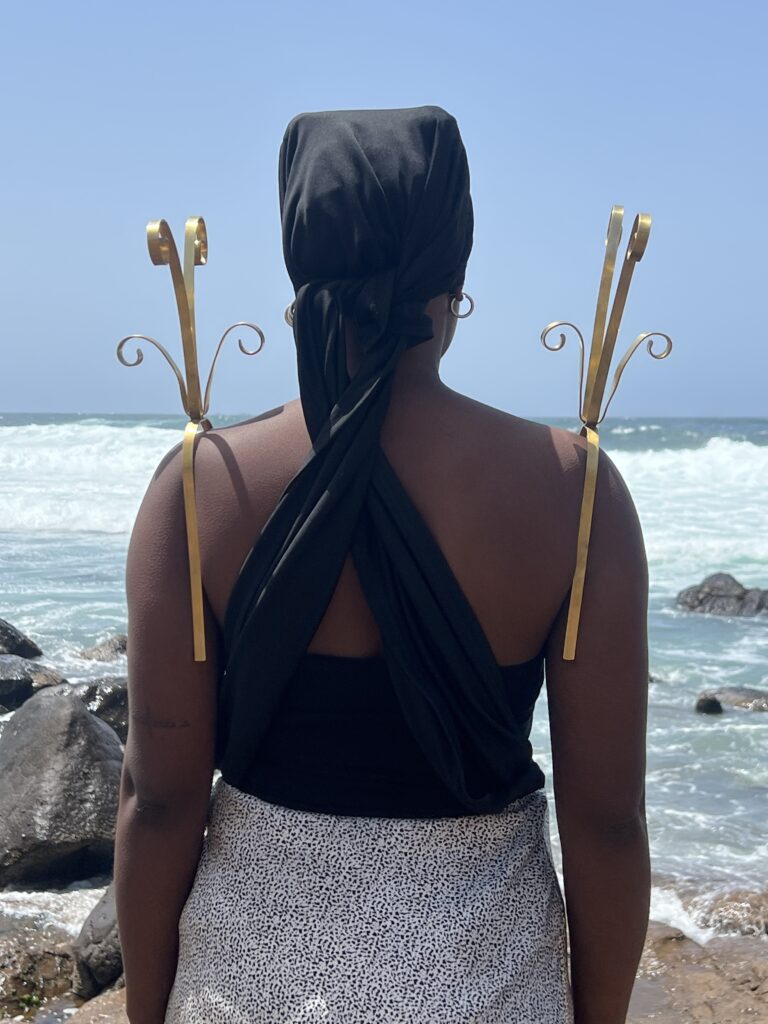
When I produced the work Mbwa: Now Mine 1, 2024, cast aluminium, in Burkina Faso in 2024, I was in residency at Village Opera. which is a telly-formed object, was made in collaboration with a local foundry where we cast recycled aluminium. I had three editions. I had two ideas for how to display two of them, and for the third one, I did not really know how, because I wanted something to speak to me. For me, display is really interesting in terms of reproduction, because reproduction itself can come with this idea of display –not only in terms of art-making or exhibition-making, but also in terms of events.
My body could have been another place to display the work. Therefore, displaying the work on my back became a kind of language, as my body was functioning as a display tool, which at the same time comes with the idea of me being seen naked. I think it was interesting for me to look at how this display itself could open other conversations beyond the object itself, and how the object could be seen and problematized in terms of display.
Your exhibitions and residencies suggest a practice grounded in research, curiosity, and long-term observation. Given the many places you could have chosen to live or study, what drew you specifically to Kumasi? What did that environment make possible for you as an artist?
If I can talk about the research, two or three years ago, a senior of mine, who is called Tracy Thompson, is a Ghanaian artist, and she mentioned her perspective on research. She said that research is not always about digging into books; maybe just chatting with friends could be research. It could be true. Many times, my friends would ask me, “Godelive, why are you dealing with the Basenji dog?” And sometimes, after a while, they would come back and ask again, “Godelive! Is it again about the Basenji?” Those questions have been relevant because they always stay in my mind: why the Basenji dog?
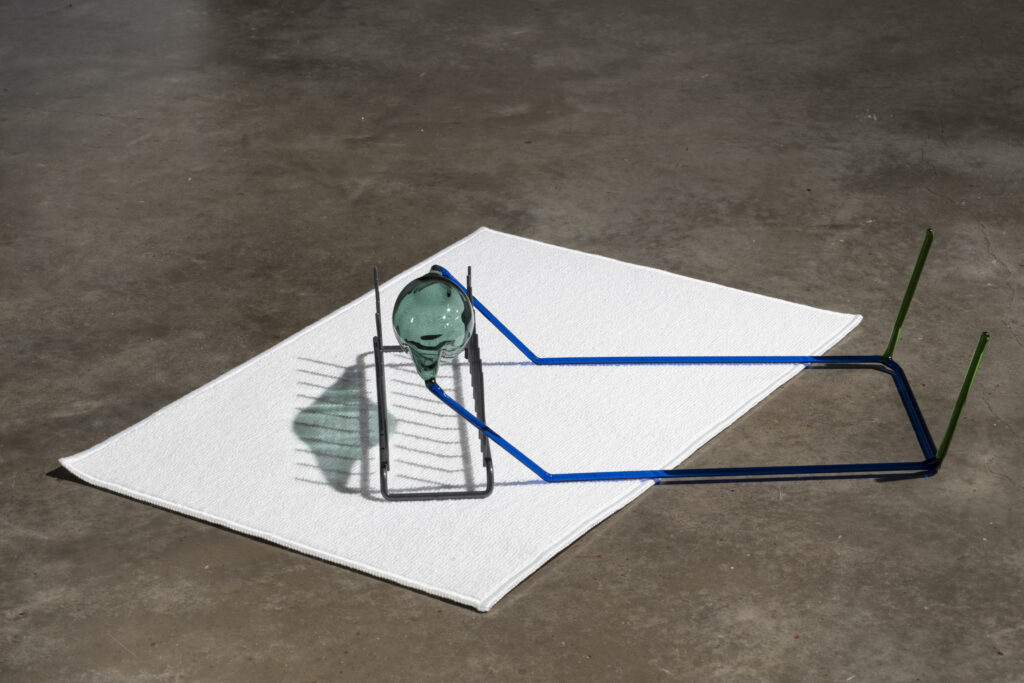
Studying at Kwame Nkrumah University of Science and Technology and being part of the Painting and Sculpture Department, which works hand-in-hand with blaxTARLINES, has shifted my perspective, especially when I read kąrî’ kạchä seid’ōu’s MFA thesis. He was discussing the tomato boxes that were sold, and are still sold, at Anloga Junction in Kumasi. These tomato boxes are always there, with marks on them, maybe the name of the owner or other inscriptions. For seid’ōu, these tomato boxes were very interesting as objects themselves because they could disrupt many things in terms of art-making, in terms of the measurement of value, and how the objects themselves propose arguments. And for me, that idea shaped my thinking about an image and the Basenji dog itself as a body.
Additionally, the idea of being in a community and how the relation between artist and artist studio functions; you can visit your artist friends, etc. Some of these discussions between artists have shifted many approaches to my work and life.
Looking at the trajectory of your work so far, one gets the sense that these projects might only represent the beginning of a much larger inquiry. Do you feel that what we’ve seen so far is just the tip of the iceberg?
I really don’t know. Maybe, maybe not. I think there are so many things to discover in the future. Whether it is like the tip of an iceberg, or the iceberg itself, I really don’t know. But I’m really interested to see this work again, maybe in the future, and see what it would look like.
I am just looking forward. since I cannot put it on a level of measurement in terms of how the inquiry could be or how it could be proposed. I think there is an excitement, maybe an iceberg of excitement and what you are seeing is just the tip of that excitement of working on this project.
Are there particular artists, whether in photography, performance, or installation, whose work has shaped or challenged your own thinking? And also after years of performances, exhibitions, and international residencies, do you feel that audiences are receiving your work in the way you hope? In other words, do you feel seen and heard through your art?
For at least three or four years, Kwasi Ohene-Ayeh’s work has been important for me, specifically his argument on possibilities and pedagogy. And there are also two of my friends, close friends, Edward Prah and Abbey IT-A. They carry my work as if it were their own. Edward is a Ghanaian artist, and so is Abbey, who uses a curatorial strategy as a mode of production. They have been so relevant to me. I remember my last residency as if we had a trio residency, because everything could have been happening at the same time; sharing content, etc.
Hassan Issa, who is a Ghanaian artist as well,I like his approach to objects, to shape, and his relationship to the city, because for him the city becomes this huge site that he usually responds to. And Ibrahim Mahama as well, his intentionality that he has put into his production. I remember when he had the exhibition at the Fruitmarket in Scotland, he asked me if I would like to write an essay about his work. I remember texting him and telling him that I know it is not going to be easy, it is going to be a challenge for me, but I would like to do so. His attitude towards me, towards this young artist writing an essay about his work, was important.
Responding to the attitude of the audience towards my work, there is one question that I really like. Sometimes people ask me multiple times, “Where is the dog then?” And I think that question has stayed so much in my mind, so where is the dog then? And sometimes the response would be: maybe it is not about the dog, maybe it is not about the image, maybe it is not about the picture as well, maybe it is about something that could be in between all of this—maybe the objects themselves.