
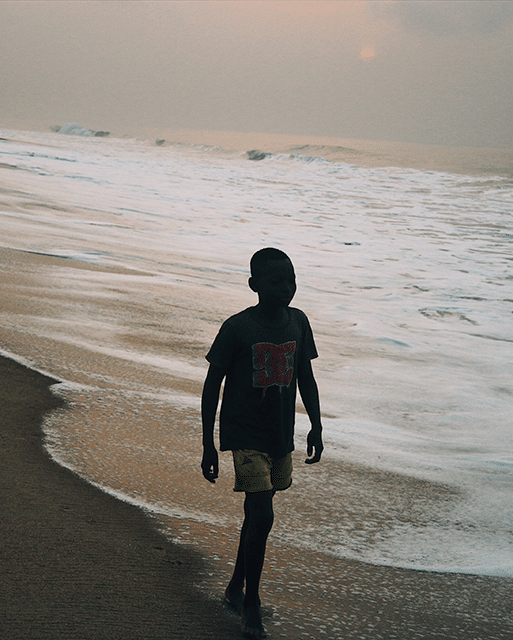
Two taps. A pause. One tap.
Patrick did it without knowing — on windowsills, on bus rails, on the wooden crate outside his aunt’s stall. His fingers just found the rhythm on their own, like they were finishing a sentence somebody else had started.
He didn’t know yet that it was the last thing his father ever taught him.
Patrick learned to count light before he learned to count money.
His aunt sold provisions near the Wuse roundabout. Every evening after school, he sat on an upturned crate outside her stall, borrowing an old Nikon from the boy who ran errands for a wedding photographer down the road. He never had film in it. He just practised the click — raise, breathe, freeze — on anyone moving fast enough to matter. Okada riders leaning into a turn. Girls skipping rope with a torn extension cable. Boys racing for a danfo before it pulled off.
Three seconds, the photographer told him once, half joking. That’s what you get before the moment closes its fist.
His father left six years earlier, not long after his mother died. No fight. No letter. Just a chair at the table that stayed empty until his aunt finally gave it to a neighbour. What Patrick kept of him wasn’t a photograph. It was that code — two taps, pause, one tap — the sound his father used to knock on his bedroom door before waking him for morning prayers. It meant I’m here before you are. Patrick still tapped it on windowsills and bus rails without noticing he was doing it.
Two shops down from his aunt’s stall sat a blind man named Baba Ori, who fixed radios. He’d been there longer than Patrick could remember — a small bench, a soldering iron, a stack of transistor sets in various stages of surrender. He never advertised. People just knew to bring him their dead radios and come back Friday.
Baba Ori listened to everything. Not just the radios. He said he could tell when a boy was running late by the weight of his footfall, when a marriage was in trouble by the way a woman greeted her husband’s voice through a doorway. He’d listened to Patrick practice his camera clicks for months before he said a word about it.
“You are always one second behind,” he told him one evening, not looking up from a circuit board. “You wait until the running has already started. By then the boy has already decided to run. You want the second before that. The deciding.”
Patrick didn’t understand what a blind man could know about watching runners. But he stopped waiting for movement after that. He started watching stillness instead — the flex of a calf before a sprint, the shift of weight into the balls of the feet. He got better. Somebody at the wedding photographer’s stall let him borrow real film once, just to see what he’d do with it.
He used it on a boy named Goody, who raced buses for sport, three or four evenings a week, just to feel the wind.
The photograph came back from the one-hour place slightly overexposed, but it worked. Goody mid-stride, both feet off the ground at once, mouth open around a laugh that hadn’t finished yet. The deciding moment, caught. Patrick pinned it above his mat that night and looked at it until he fell asleep.
He wanted to show Baba Ori, except Baba Ori couldn’t see photographs. Patrick almost turned back, embarrassed at himself. But the old man was at his bench as always, hands moving over a radio’s insides like he was reading a face.
“I took a good one,” Patrick said instead. “The kind you talked about.”
“Then you don’t need me to tell you,” Baba Ori said. “You already know it in your chest.”
Patrick sat on the bench edge, restless with the small pride of it, drumming his fingers against the wood without thinking — two taps, pause, one tap. A habit so old it wasn’t even a thought anymore.
Baba Ori’s hands went still over the radio.
“Where did you learn that,” he said. Not really a question. His voice had changed shape.
Patrick stopped tapping. “My father used to do it. Before he left.”
The old man didn’t answer for a long time. The street kept moving around them — a horn, a woman calling a child in from the road, the frying oil hissing from the food stand across the way. Baba Ori set the screwdriver down with a care that seemed to cost him something.
“Do it again,” he said.
Patrick did. Two taps, pause, one.
Baba Ori tapped it back. Perfectly. Like he’d been keeping it somewhere and only now took it out.
“I was in an accident,” he said finally, “before you would remember me clearly. A generator fire, at the old workshop on Kubwa road. I lost the sight in both eyes, and most of what I thought a man was supposed to be for his family after that. I did not know how to be a father with no eyes to watch his son grow. So I decided your aunt should raise you as a man who left, rather than a man who stayed broken. I moved two streets away, and I have listened to you become someone for six years without once telling you I was close enough to hear it.”
Patrick didn’t move. Somewhere behind him a bus braked hard and somebody shouted at the driver — ordinary noise going on being ordinary, indifferent to the fact that the ground had just shifted under a fifteen-year-old boy on a wooden bench.
“You said I wait too long to press the shutter,” Patrick said eventually, because it was the only sentence he could find. “You’ve been doing the same thing.”
Baba Ori almost laughed, a short broken sound. “Then I suppose we are both one second behind.”
Patrick still had the camera around his neck, though there was no film left in it. He raised it anyway, out of instinct more than intention, and pointed it at his father’s hands resting on the workbench — old, scarred faintly along the knuckles from the fire, still holding themselves in the shape of two taps and a pause.
He pressed the shutter on nothing. It didn’t matter. Some moments don’t need film to be kept.
He sat back down, closer than before, and let his shoulder rest against his father’s arm. Neither of them said anything else. On the street, the evening kept its noise, unaware that between the frying oil and the horns, a boy had finally caught the picture he’d been chasing his whole life — not a stranger mid-run, not a decisive moment stolen from someone else’s story, but his own, arriving one second late and somehow exactly on time.