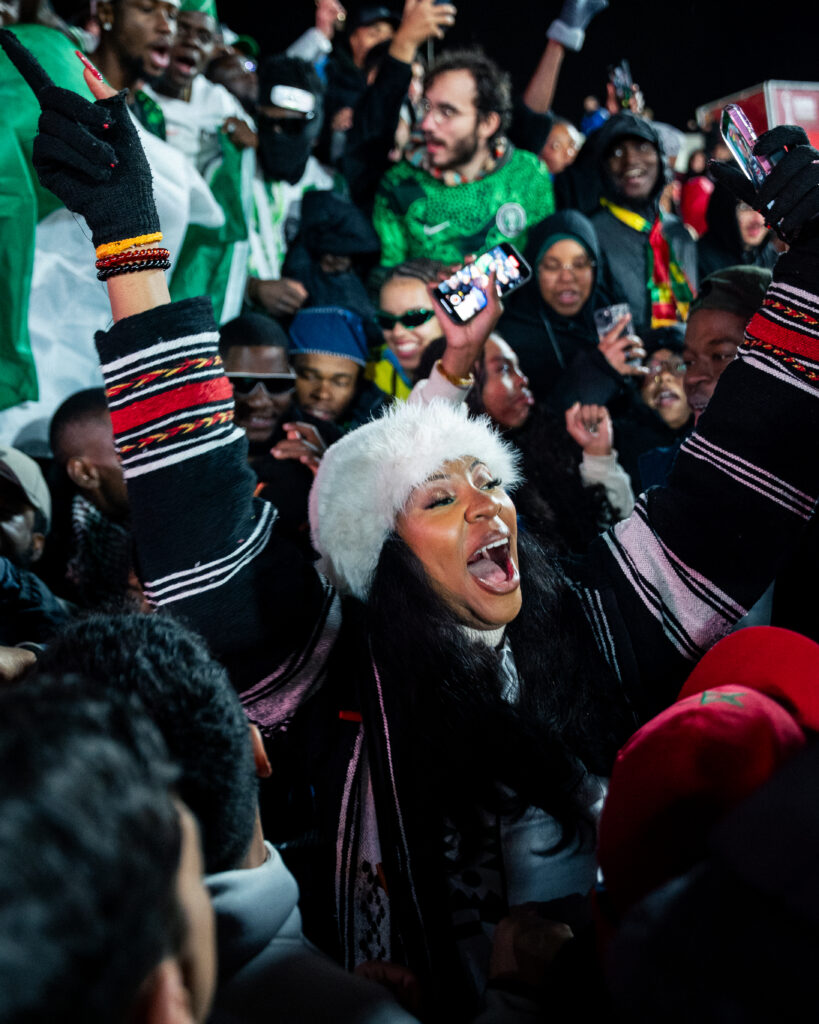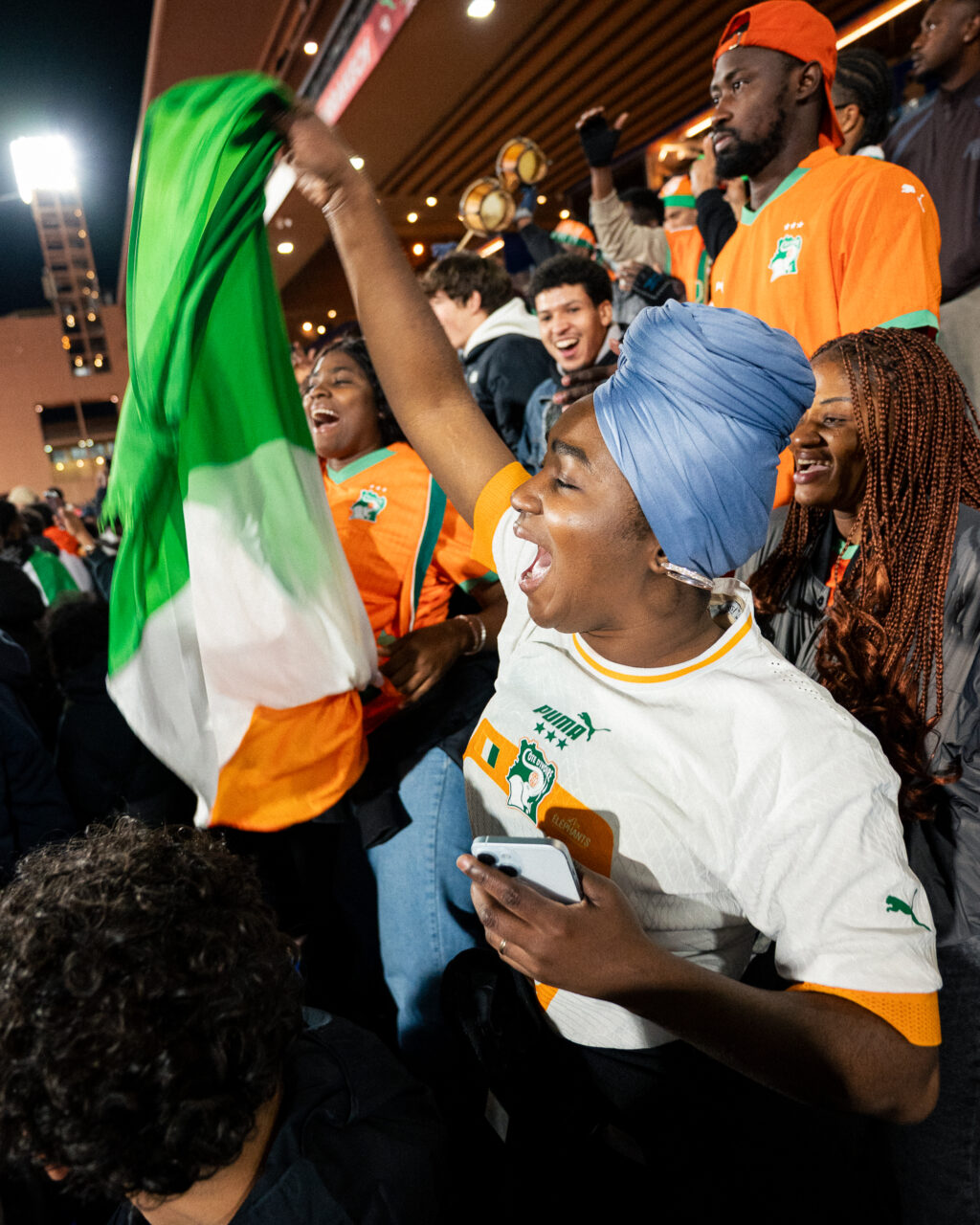
Sophia Daoud’s photographic practice centres people as the emotional architecture of public life. Working across documentary and portraiture, she is interested in the spaces where identity, community, and collective experience take shape, photographing people not as figures on the periphery of events, but as the forces that give them meaning.
Working within the field of football photography, Daoud constructs images that interrogate the relationship between spectatorship, participation, and collective identity. Her practice is attentive to the politics of visibility: how people assemble, perform fandom, and inscribe themselves into public space. By focusing on the affective dimensions of crowds, ritual, and communal gathering, she reframes football photography as a means of tracing emotional and social infrastructures rather than simply recording events. Photographing football is both deceptively simple and genuinely difficult. It is easy to produce a familiar image of a player striking the ball, yet far more challenging to construct an image that carries narrative weight. This is where Daoud’s work becomes distinct.
Her strength lies in her ability to move beyond the expected frame and into the lived atmosphere of the game, where emotion, spectatorship, and collective presence become the subject itself. This sensibility extends beyond photography into her wider visual practice. As a film producer or football manager, she operates with the same attentiveness to rhythm, energy, and human presence, remaining closely involved in the construction of each image and scene. A notable example is her involvement in the Nike campaign featuring Jay-Jay Okocha, produced in Morocco shortly after AFCON. It is within this same context that we first encountered her work, situating her practice within a broader field of contemporary football image-making that moves between documentary, editorial, and commercial space.
In this exclusive interview with Random Photo Journal, we revisit Sophia Daoud’s latest exhibition at OSCAM in Amsterdam, Netherlands, titled AFCON for the People.
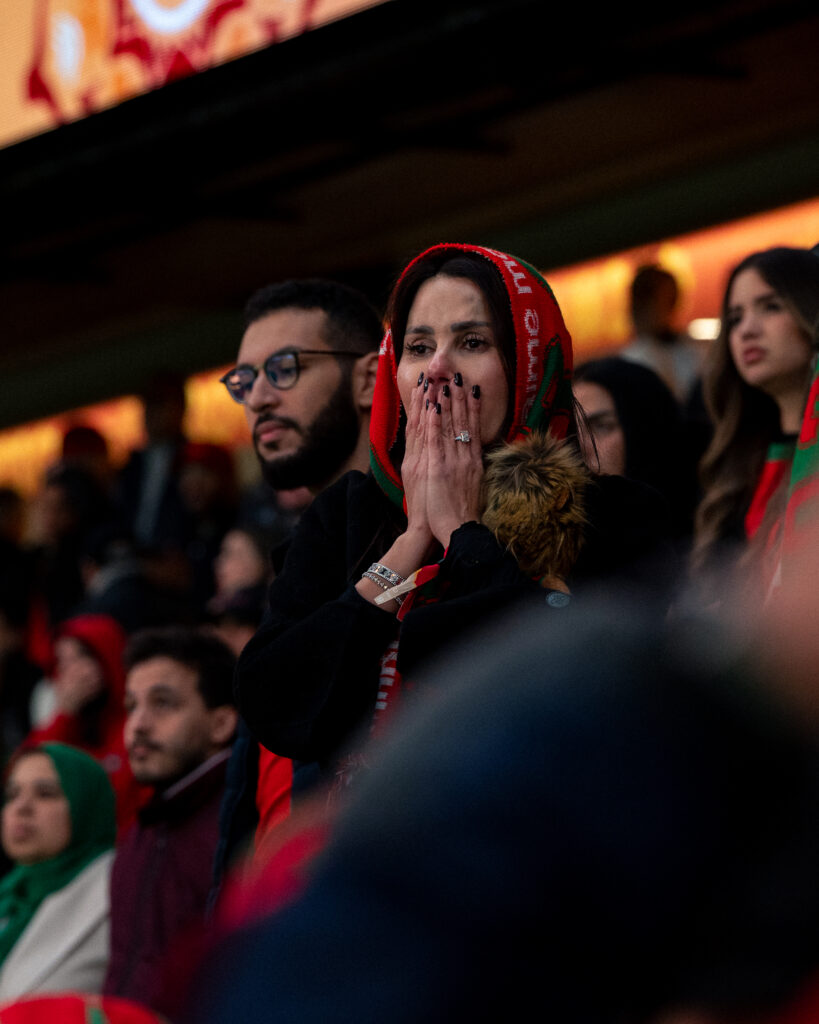
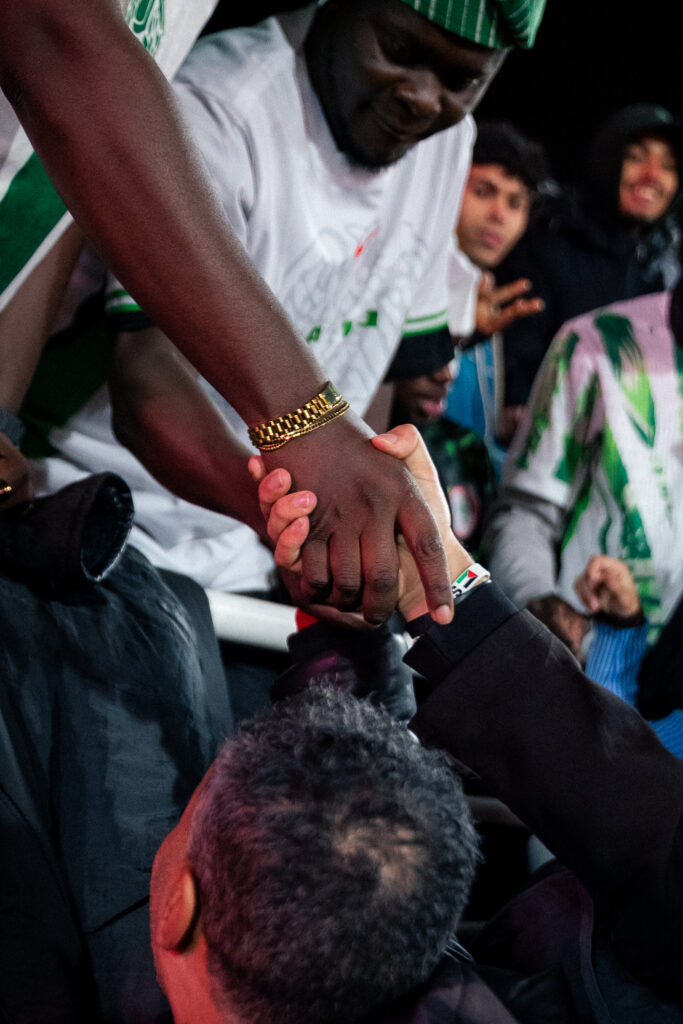
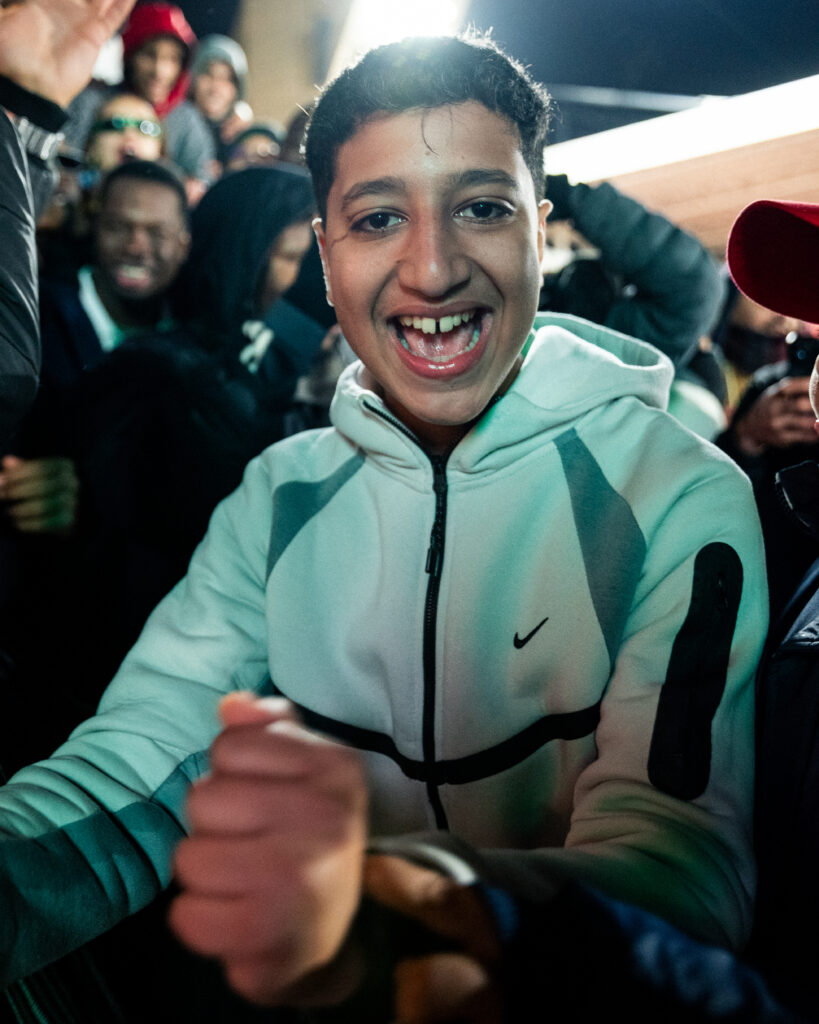
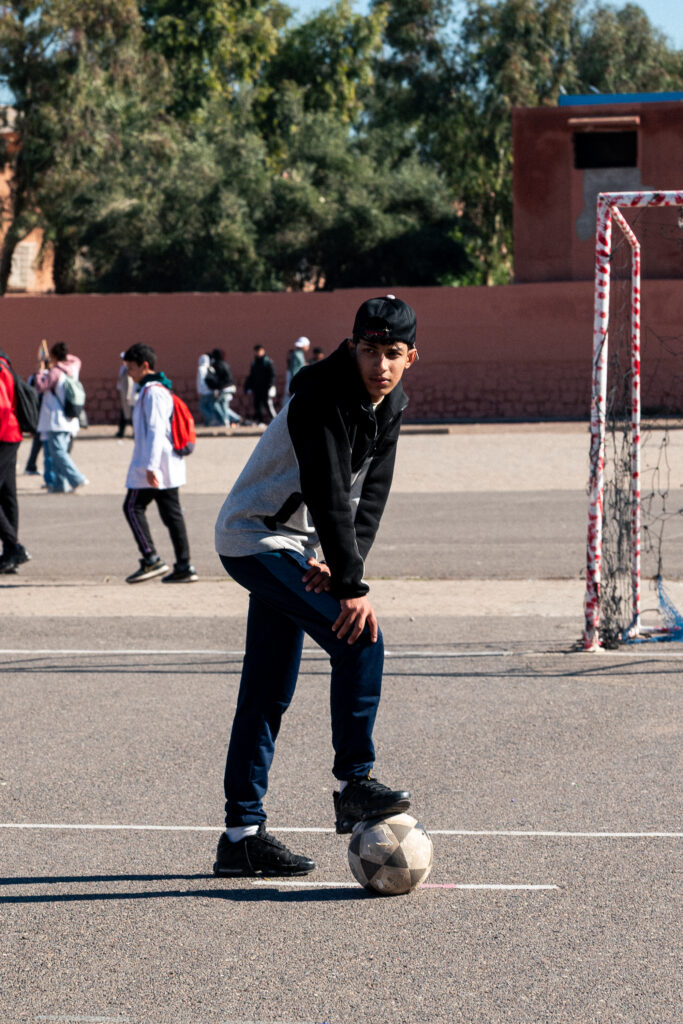
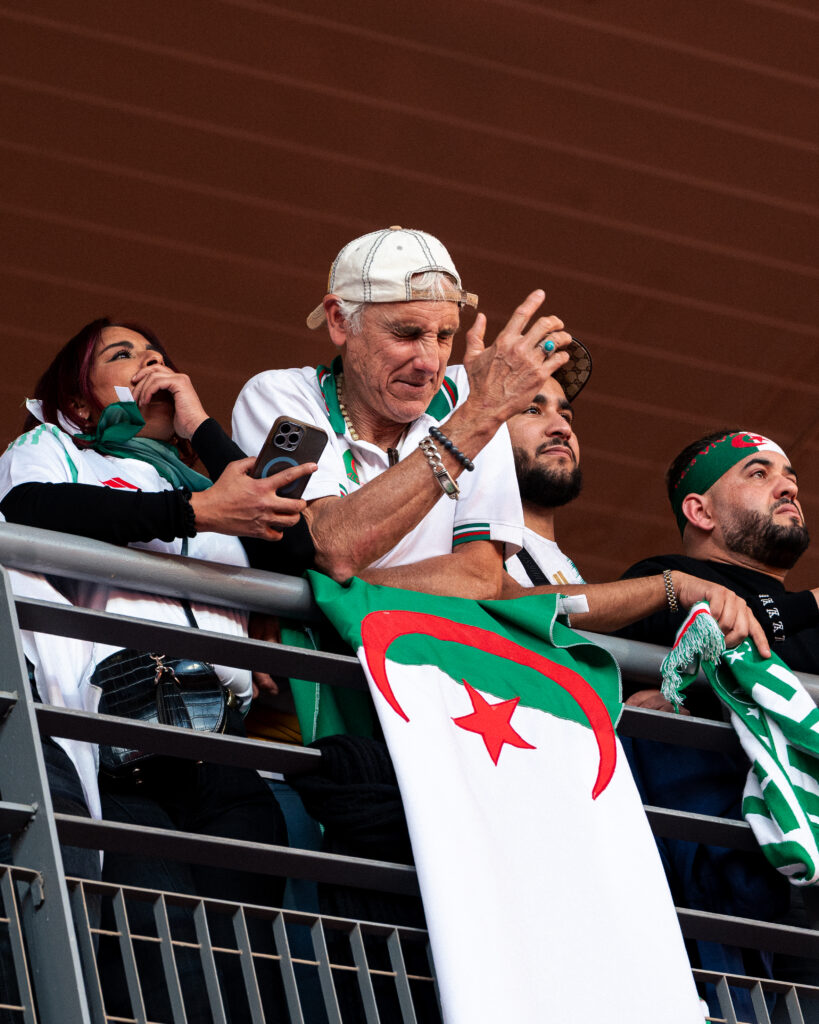
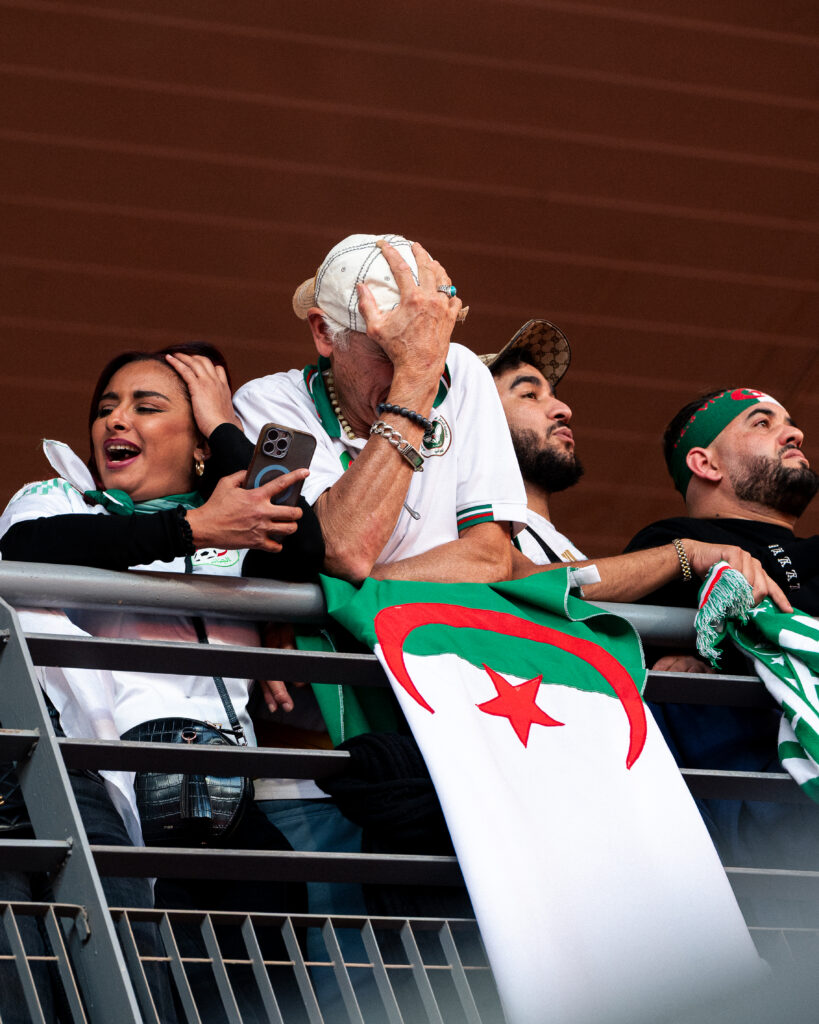
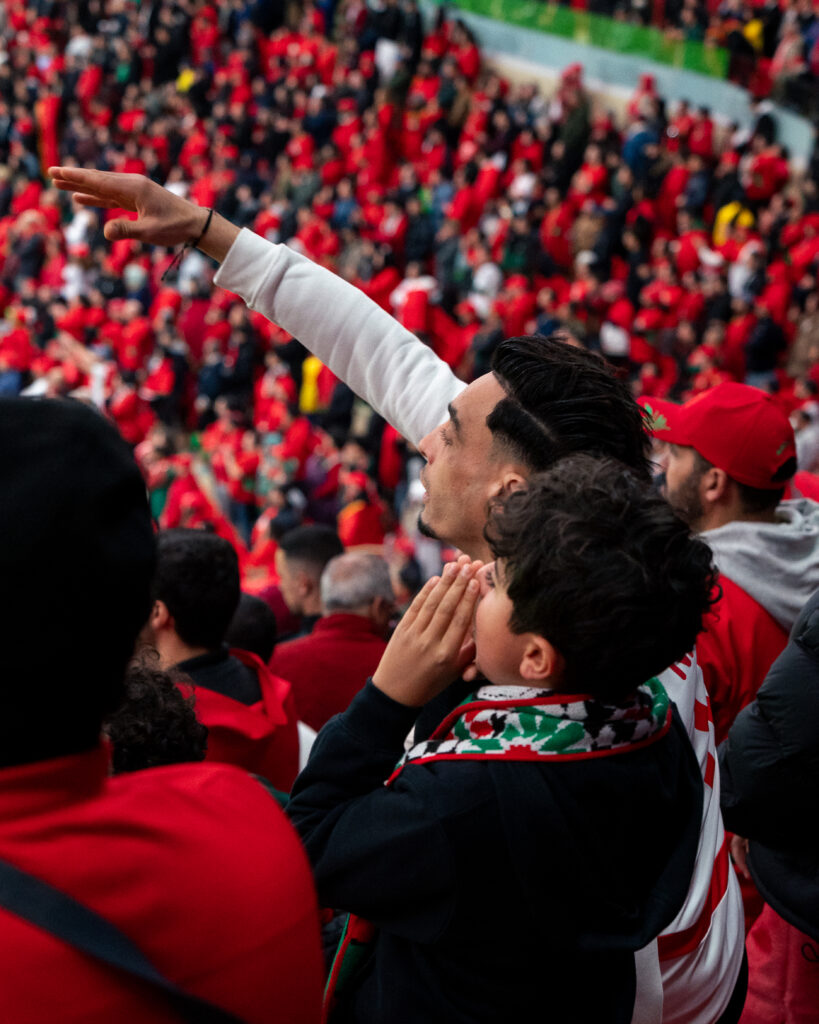
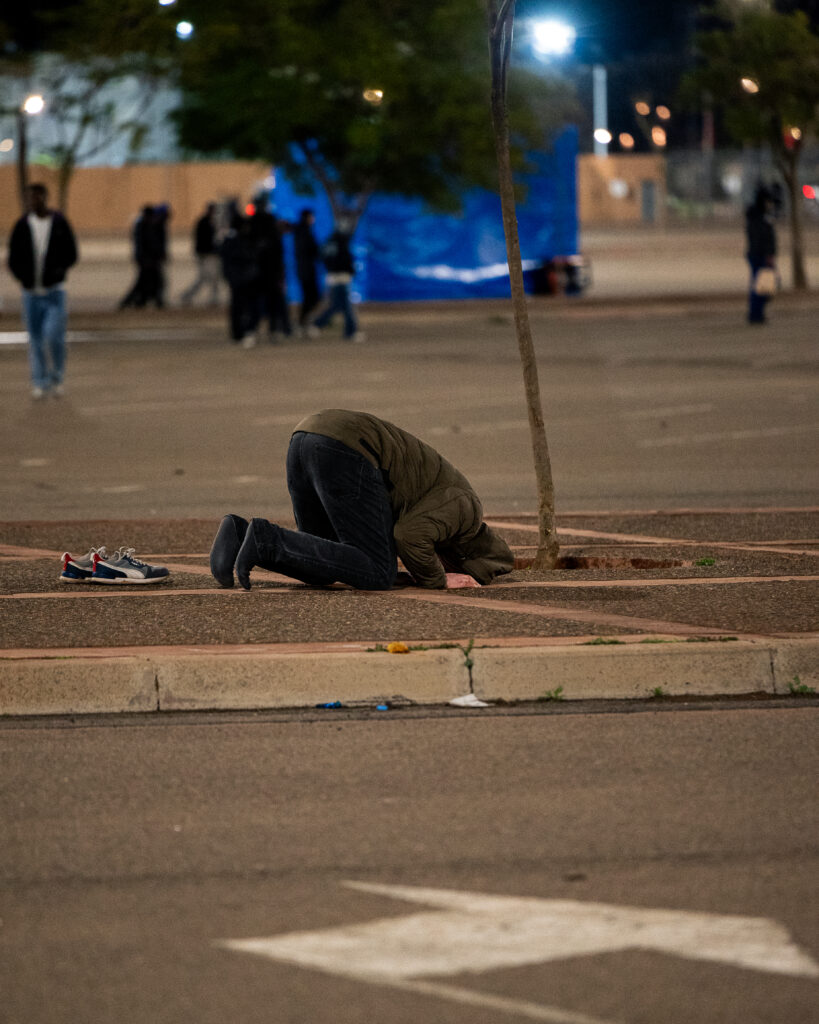
Developed during the 2025 Africa Cup of Nations in Morocco, AFCON for the People approaches football not simply as sport, but as a site of collective feeling. By centring supporters, the series shifts attention away from the action on the pitch and toward the communities that animate the game itself: the people who create atmosphere, sustain memory, and give football its emotional weight. Across these photographs, crowds become choreographies of colour and gesture; stadiums transform into spaces where pride, longing, joy, and belonging are performed publicly. What emerges is not simply a record of spectatorship, but a portrait of participation itself.
Your work seems to centre a lot on people and their everyday atmosphere. How do you approach capturing authentic emotions, or are some of your images staged?
A lot of my work begins with observation. I’m deeply drawn to people, their emotions, and the atmosphere around them, so I naturally stay tuned in to moments as they unfold, whether that means spending some time watching before I ever press the shutter or reacting instantly when emotion reveals itself. Within AFCON For The People, that connection becomes even more personal because I’m not just documenting supporters from the outside; I’m one of them. I’m part of that energy, and because I understand what people are feeling in those moments- the pride, tension, joy, and anticipation- it becomes easier to recognise and capture those emotions. All of that work is entirely candid. Nothing is staged because the power of it comes from its truth.
In my wider work, my instinct is still rooted in observation. Even when I’m working with clients, and there’s naturally more direction involved, I don’t approach it by trying to manufacture emotion. Direction, for me, is more about creating the right space or environment for something real to surface. Whether I’m capturing something candid or guiding a subject, the goal is always the same: to create images that evoke emotion and make people feel something real.
You seem to experiment with different techniques. What’s one creative risk you took in your photography that really paid off?
I think the biggest creative risk I took was fully embracing the kind of photographer I naturally am, rather than the photographer I thought I should be. For a period of time, especially as I started working with clients, I found myself moving away from my instinctive style. The work became more directed, more polished, and while there’s absolutely value in that, I noticed that my personal work always felt more meaningful to me. Choosing to fully trust my instincts was a risk because it meant accepting that not everyone would immediately connect with the work. But it paid off because the photographs became more honest. They started to feel less like images I thought I should make and more like images I genuinely wanted to make. It’s definitely harder to translate that approach into commercial work because there are often more limitations, whether that’s a brief, client expectations, or the purpose of the images. My personal work is where I have the freedom to fully explore my voice, and embracing that voice has given me a lot more confidence in my work. It’s allowed me to stop second-guessing myself and trust my instincts more, both as a photographer and as a storyteller.
When shooting events or fast-moving scenes, how do you decide what not to capture?
To be honest, I don’t consciously think about what not to capture. I’m more focused on what draws me in. In fast-moving environments, there are hundreds of moments happening at once, and they’re all important in their own way. But instinctively, you gravitate towards certain things. Some moments grab my attention, and others simply don’t. There are also plenty of moments that I’m just not there for. You can’t shoot everything, and that’s fine. Sometimes you capture a moment and only realise later, during the edit, that it doesn’t belong in the final story. That’s often where the story comes together most strongly. I think every photographer develops their own filter over time. Mine naturally gravitates towards people and emotion. If a moment doesn’t make me curious, doesn’t make me feel something, or doesn’t add to the story I’m trying to tell, I usually let it pass. Not every moment needs to become a photograph. Other times, the most meaningful thing I can do is not take the picture at all, but simply experience the moment rather than document it.
How has your style evolved from your early work to what you’re posting now on Instagram?
It’s funny, actually, because I didn’t consciously start with this style. I began in festival and music photography, but even then I was never the type of photographer who was obviously in people’s faces. If anything, I was usually somewhere in the background, lurking a little. Part of that was personal. I never really liked the attention, so even if I was on stage with artists, you’d often find me in corners where I wasn’t too visible. Some of that was definitely anxiety too. But another big part of it was perspective. As someone who genuinely loves festivals, I’ve never liked having cameras constantly in my face, so that naturally shaped how I approached photographing other people. That slowly became my style. Instead of forcing presence, I became more observational, more focused on capturing emotion from a distance without interrupting it. Over time, especially when I started working more with clients, I found myself stepping away from that instinct a little. The work became more directed, and while that taught me a lot, it also sometimes felt less like me creatively. Where I’m at now, I’ve fully embraced that this style of photography, observational, atmospheric, and emotionally driven, is who I am. It feels the most natural, and because of that, the work feels the most truthful.
How did you find football, the passion for it? Because football is such a dynamic and emotional sport, what draws you to it personally and visually compared to other subjects?
I’ve always loved football. Growing up, I was basically attached to my brother’s hip, and because football was everything to him, it naturally became everything to me too. You’d always find me with a ball at my feet, and if I wasn’t playing, I was pretty much watching any game I could find on a stream. In a different life, I would’ve loved to be a football player. Even though that path looked different for me, football has never really left. These days, it remains a huge part of my life, both through the work I create around it and the spaces I’m building within it. I founded my own women’s football team in Amsterdam called AMAAN C.F. AMAAN comes from the Somali word Amano, which speaks to trust, safekeeping, and responsibility, while C.F. is a nod to my favourite club, Real Madrid. But beyond the name, AMAAN means something much deeper to me. It represents a purpose entrusted to me, a responsibility I carry with care. The team in Amsterdam is only the beginning. The bigger vision is to one day grow that into a football academy in Somalia, with the hope that it can help develop future generations and contribute to representing the country on a larger stage.
What draws me to football and sport in general is that it’s never just been about the game itself. From a young age, it felt like something much bigger, a space where emotion, identity, community, and possibility all existed at once. It has the power to unite people across differences in ways very few things can, and that idea has stayed with me ever since. Seeing the impact Didier Drogba had on Ivory Coast was one of the earliest examples that showed me what football could mean beyond the pitch. It showed me that football could be a force for something bigger than itself, and in many ways, that shaped how I began to think about my own purpose. Football also opened my eyes to the world. Long before I ever had the opportunity to travel, it became a window into different cultures, languages, and communities. Through the game, I got a glimpse into lives and places far beyond my own surroundings. In many ways, it was my first passport.
Do you approach photographing football more like storytelling (capturing narratives) or like freezing peak action moments?
I definitely lean more towards storytelling. Don’t get me wrong, I appreciate a great action shot, but I’m rarely chasing the ball around the pitch. What interests me is where the emotion lives. Even when it comes to performance-based images, whether that’s football, music, or any other live event, I’m usually more interested in the passion behind the performance than the performance itself. It’s rarely the action that catches my eye first; it’s the emotion behind it. A player celebrating a tackle as if they’ve just scored a winning goal, a coach reacting to a missed chance, or the tension written across someone’s face before a crucial moment. Those are the moments I’m looking for. The action provides context, but it’s the human reaction that makes an image memorable. Anyone can tell you what happened in a match by looking at the scoreline. Photography allows us to show what it felt like.
How long did it take you to set up your latest exhibition, and what has it taught you about yourself as an artist? Also, I know you just put out new work, but artists always work on series of projects. Given that, are there other projects from you that are in the works?
The exhibition taught me a lot about myself as an artist. I don’t think I realised quite how much I cared about the process until I was in the middle of it. It brought out a level of perfectionism I didn’t know I had. I found myself thinking about everything: how the images were placed, how large they should be, the order people would experience them in, where the lighting should go, and most importantly, what I wanted people to feel as they moved through the space. In many ways, it took months to prepare, but mentally it took even longer. I made the decision during AFCON 2024 that I wanted to create this exhibition. In September 2025, I started the actual preparations: applying for accreditation, planning the trip to Morocco, exploring which museum to work with, and shaping what I wanted the final exhibition to become. Once I returned, the focus shifted to building the exhibition itself. The selection process was probably the hardest part. Taking photographs is one thing, but deciding which images tell the story best is something else entirely.
Before this project, I don’t think I fully appreciated how much work goes into turning a collection of photographs into an exhibition. It’s one thing to create individual images, but it’s another to build an experience around them. That process taught me that I care deeply not just about the photographs themselves, but about how stories are presented and experienced. What I loved most was the response. Seeing friends, family, and members of my community show up to support the work was incredibly special. But I also loved seeing strangers walk through the doors, people who somehow found out about the exhibition and decided to spend time with the work. It was a reminder that photography can create connections far beyond the people you already know. As for what’s next, AFCON For The People was never intended to be a standalone project. It’s part of a larger body of work called Football For The People, which explores football through the people who live it. The long-term vision is to continue building that project across different communities, cultures, and countries, and eventually turn it into a much larger exhibition. AFCON For The People was one chapter of that story, but there are many more still to be told.